






Table of Contents
ToggleVirgin Bitcoin – TOR Scam Report (211)
Onion Link : http://torbaymimewskrgqn5iur36oequsg5eqvypf5gx5yoedpopmbxcea5qd.onion
Scam Report Date: 2025/03/25
Client Scam Report Breakdown
Original Report Summary:
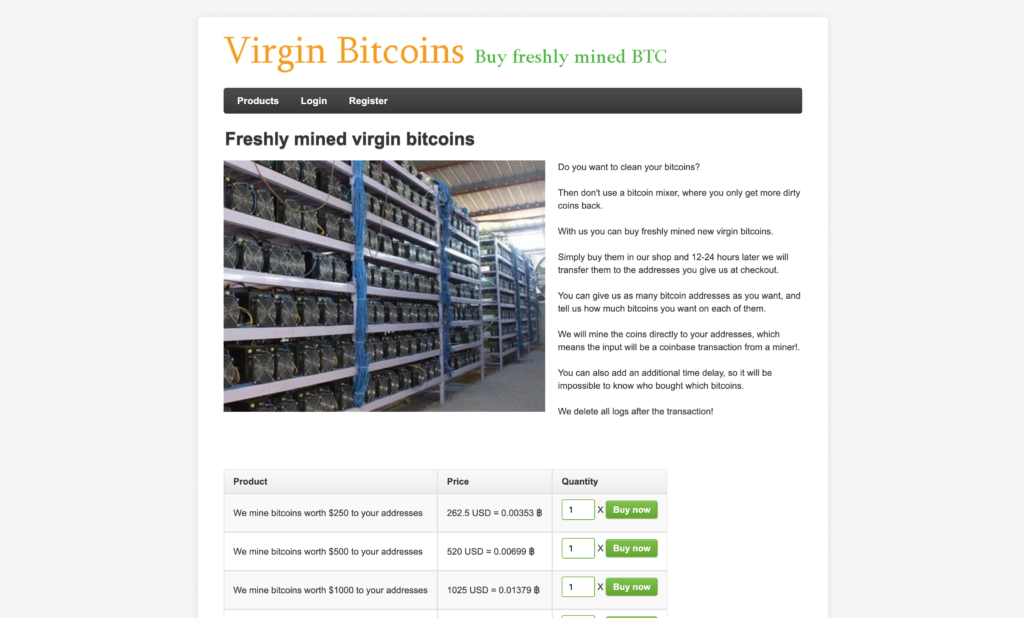
The original scam report submitted indicates that the service “Virgin Bitcoins” advertises itself as a provider of “freshly mined virgin bitcoins” delivered directly to user-specified wallet addresses. The platform claims that users can purchase Bitcoin in fixed-value packages (e.g., $250, $500, $1000 tiers), which will then be “mined” and transferred to their wallets within a short processing window of 12–24 hours. It further claims that the Bitcoin delivered originates from coinbase mining transactions, and that users can optionally introduce time delays or split deliveries across multiple addresses to increase anonymity.
The report indicates that after initiating a purchase, users do not receive verifiable proof of mining activity, nor do transaction patterns align with actual blockchain mining behavior. Instead, funds appear to originate from pre-existing wallets with no demonstrable link to mining pools or block reward generation. Additionally, the service promotes the idea of “clean” or “virgin” Bitcoin, implying that coins sourced through this platform are inherently untraceable or free from prior transactional history.
If accurate, this would classify the platform as a structured financial misrepresentation scheme, where mining terminology is used as a marketing front to justify the redistribution of pre-existing cryptocurrency under false operational claims.
Defining Terminology and Terms Throughout the Report
To properly evaluate this system, it is necessary to define key concepts related to cryptocurrency mining and transaction integrity.
A coinbase transaction refers to the special first transaction in a Bitcoin block that generates newly minted Bitcoin as a reward for miners who successfully validate a block. These outputs are publicly recorded on the blockchain and are not privately assignable to retail purchasers. Therefore, any claim that coinbase outputs can be “purchased” or selectively delivered to individuals on demand is inconsistent with Bitcoin’s protocol design.
The term “virgin Bitcoin” is not a technical classification within the Bitcoin network. It is a colloquial marketing term sometimes used to describe coins with no prior transaction history, but even this is not absolute, as all Bitcoin can be traced back to coinbase events via the public ledger.
A mining operation refers to computational processes performed by miners or mining pools that validate transactions and secure the network. Mining rewards are distributed according to hash power contribution and pool rules, not through individualized retail purchase orders or fiat pricing tiers.
The concept of transaction obfuscation via delayed delivery refers to intentionally delaying fund transfers to reduce correlation between payment time and receipt time. While timing variation can be used in legitimate operational contexts, in fraudulent structures it is often used to disrupt traceability and attribution analysis.
Final Analysis and Recommendations
Based on the reported behavior and operational claims, the “Virgin Bitcoins” platform exhibits strong indicators of a non-technical reinterpretation of Bitcoin mining used as a financial abstraction layer for redistribution of pre-existing funds. The service’s core claims—on-demand mining, guaranteed clean coins, and controllable coinbase issuance—are not consistent with the functional architecture of the Bitcoin network.
The use of fixed pricing tiers for Bitcoin delivery suggests a pre-funded conversion model rather than probabilistic mining output, while the absence of verifiable mining pool attribution indicates that outputs are likely sourced from existing liquidity pools or recycled wallet clusters.
The marketing emphasis on “clean,” “virgin,” or “untraceable” Bitcoin further reinforces a compliance-framed narrative designed to appeal to users seeking transactional opacity, despite the inherent transparency of blockchain systems.
Users interacting with systems of this structure face a high probability of receiving:
-
non-mined pre-existing Bitcoin redistributed through intermediary wallets
-
inconsistent transaction provenance unrelated to mining activity
-
or non-delivery outcomes depending on operational continuity
Given the lack of verifiable mining linkage, auditability, or transparency mechanisms, this platform should be treated as a high-risk financial misrepresentation service built around simulated mining narratives rather than actual block reward generation.